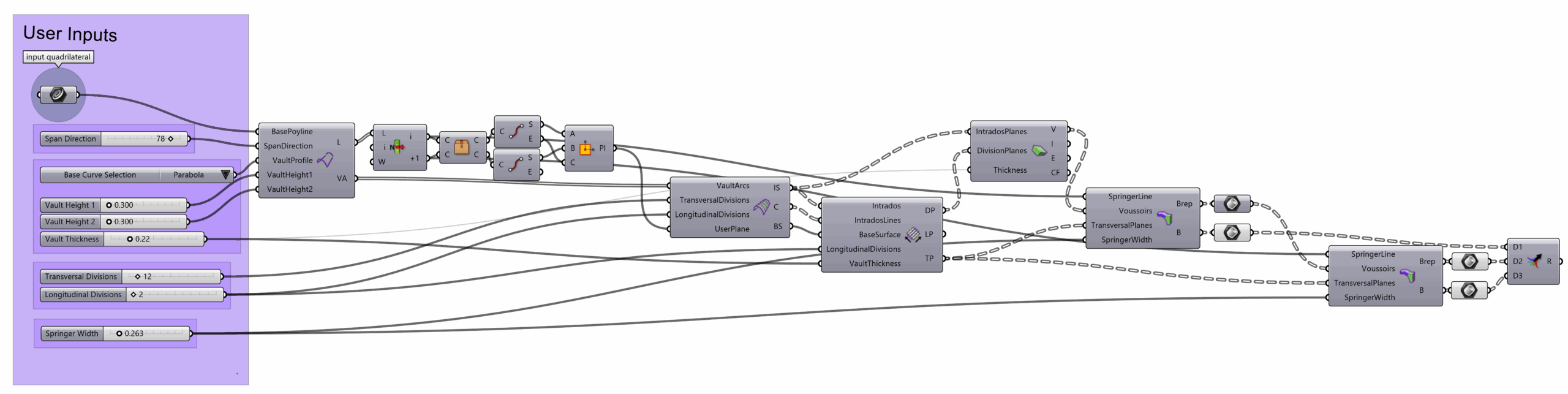
The parametric modelling of an irregular vault in Grasshopper begins with the definition of a planar quadrilateral curve that serves as the base profile. This curve is subdivided into its constituent segments and, by assigning the desired vault height, four fundamental base curves are generated: two transversal arcs, derived from the specified height, and two support lines. A loft operation between the arcs produces the initial vault surface, which is then subdivided into the individual intrados of the voussoirs. For this subdivision, the user specifies the number of longitudinal and transversal divisions, defined by the “u” and “v” values, which correspond respectively to the number of voussoirs along the span and the number of courses across the height of the vault.
From the resulting grid points, transversal and longitudinal planes are constructed to establish the contact surfaces between voussoirs. These planes form the basis for generating the planarized intrados, obtained through a fit plane operation. To generate the extrados, each intrados plane was offset along a normal vector calculated by averaging the directions of the adjacent division planes.
Finally, the springers were modelled selecting the voussoirs that intersect with an imaginary wall that has as its base the springer line, and then for each transversal set of voussoirs obtaining the highest “Z” coordinate and creating an extrusion with that height and a given width that is then fused to the selected voussoirs.
All the new components created in the scope of this Grasshopper definition can be found on the Turtle article.